The Radio Receiver

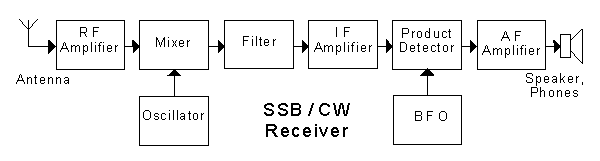
In the block diagram of the receiver shown, the "RF amplifier"
-
decreases random fluctuation noise
-
is a restoring filter amplifier
-
Correct Answerincreases the incoming signal level
-
changes the signal frequency
Correct answer: C — increases the incoming signal level
The RF amplifier is the first active stage after the antenna in this SSB/CW superhet receiver. Its primary job is to boost the weak signal picked up by the antenna before it reaches the mixer, improving the overall sensitivity of the receiver. By amplifying the signal early in the chain, the RF amplifier also helps establish a good signal-to-noise ratio for subsequent stages.
Looking at the block diagram, the signal path flows: Antenna → RF Amplifier → Mixer (combined with the Oscillator) → Filter → IF Amplifier → Product Detector (with BFO) → AF Amplifier → Speaker/Phones.
- A — decreases random fluctuation noise: Incorrect. An RF amplifier adds some noise of its own; it does not decrease random (thermal) noise. A low-noise design minimises added noise, but noise reduction is not its primary function.
- B — is a restoring filter amplifier: Incorrect. There is no standard stage called a "restoring filter amplifier." Filtering is performed by the dedicated Filter block that follows the mixer.
- D — changes the signal frequency: Incorrect. Frequency conversion is the role of the Mixer stage, which combines the RF signal with the local Oscillator to produce the intermediate frequency (IF).
Therefore, the RF amplifier's role is simply to increase the level of the incoming signal from the antenna before it enters the mixer stage.
Last edited by jim.carroll. Register to edit
In the block diagram of the receiver shown, the "mixer"
-
Correct Answercombines signals at two different frequencies to produce one at an intermediate frequency
-
combines sidebands to produce a stronger signal
-
discriminates against SSB and AM signals
-
inserts a carrier wave to produce a true FM signal
Correct answer: combines signals at two different frequencies to produce one at an intermediate frequency
In a superheterodyne receiver, the mixer takes:
- the incoming RF signal
- the local oscillator signal
and combines them to produce new frequencies:
\[ f_{\text{sum}} = f_{\text{RF}} + f_{\text{LO}}, \quad f_{\text{diff}} = |f_{\text{RF}} - f_{\text{LO}}| \]
One of these (usually the difference) is selected as the intermediate frequency (IF) for further processing.
- It does not combine sidebands.
- It does not discriminate between modulation types.
- It does not insert a carrier.
Therefore, the mixer combines signals at two different frequencies to produce one at an intermediate frequency.
Last edited by jim.carroll. Register to edit
In the block diagram of the receiver shown, the output frequency of the "oscillator" is
-
the same as that of the incoming received signal
-
the same as that of the IF frequency
-
Correct Answerdifferent from both the incoming signal and IF frequencies
-
at a low audio frequency
Correct answer: C — different from both the incoming signal and IF frequencies
In a superheterodyne receiver, the local oscillator (labelled "Oscillator" in the diagram) feeds the Mixer stage. The mixer combines the incoming RF signal with the oscillator signal to produce the Intermediate Frequency (IF). The IF is the difference (or sum) of the RF and oscillator frequencies, so the oscillator frequency must be offset from both the received signal frequency and the IF frequency. Typically the oscillator runs above the incoming signal by exactly the IF frequency (e.g., if the signal is 7.000 MHz and the IF is 455 kHz, the oscillator runs at 7.455 MHz).
\[ f_{\text{IF}} = f_{\text{OSC}} - f_{\text{RF}} \]
Example:
-
Received signal: 7.000 MHz
-
IF: 455 kHz = 0.455 MHz
-
Required oscillator frequency: 7.000 + 0.455 = 7.455 MHz
-
A. the same as the incoming received signal — Incorrect; if the oscillator matched the RF exactly the IF output would be zero (DC), not a usable intermediate frequency.
-
B. the same as the IF frequency — Incorrect; the IF is the product of mixing, not the oscillator frequency itself.
-
D. at a low audio frequency — Incorrect; that describes the BFO (Beat Frequency Oscillator), which is a separate block in this diagram used to reinsert a carrier for SSB/CW detection.
Therefore, the local oscillator must operate at a frequency distinct from both the received RF signal and the IF, offset by exactly the IF value so the mixer can produce the correct intermediate frequency.
Last edited by jim.carroll. Register to edit
In the block diagram of the receiver shown, the "filter" rejects
-
AM and RTTY signals
-
Correct Answerunwanted mixer outputs
-
noise bursts
-
broadcast band signals
Correct answer: unwanted mixer outputs
In a superheterodyne receiver, the mixer produces multiple frequency components:
- sum frequency (\(f_{\text{RF}} + f_{\text{LO}}\))
- difference frequency (\(|f_{\text{RF}} - f_{\text{LO}}|\))
- other unwanted products
The filter stage selects the desired intermediate frequency (IF) and rejects the unwanted mixer outputs.
- It is not specifically rejecting AM or RTTY signals.
- Noise bursts are handled elsewhere.
- Broadcast band signals are not the specific target here.
Therefore, the filter rejects unwanted mixer outputs.
Last edited by jim.carroll. Register to edit
In the block diagram of the receiver shown, the "IF amplifier" is an
-
isolation frequency amplifier
-
intelligence frequency amplifier
-
indeterminate frequency amplifier
-
Correct Answerintermediate frequency amplifier
Correct answer: intermediate frequency amplifier
In a superheterodyne receiver, signals are converted to a fixed frequency called the intermediate frequency (IF).
The IF amplifier:
-
amplifies this fixed-frequency signal
-
provides most of the receiver’s gain and selectivity
-
The other options are not valid technical terms.
Therefore, IF stands for intermediate frequency amplifier.
Last edited by jim.carroll. Register to edit
In the block diagram of the receiver shown, the "product detector"
-
produces an 800 Hz beat note
-
separates CW and SSB signals
-
rejects AM signals
-
Correct Answertranslates signals to audio frequencies
Correct answer: D — translates signals to audio frequencies
In an SSB/CW receiver, the product detector is the final demodulation stage. It mixes the Intermediate Frequency (IF) signal with the output of the Beat Frequency Oscillator (BFO) to produce the difference frequency, which falls in the audio range. This is the process of "translation" — converting the IF signal down to audible frequencies that can then be amplified by the AF amplifier and heard through the speaker or headphones.
In the block diagram, the BFO feeds directly into the product detector, confirming this mixing role. The resulting audio signal passes to the AF amplifier stage on the right.
- A. produces an 800 Hz beat note — An 800 Hz tone is one possible output when receiving CW (by offsetting the BFO appropriately), but this describes only one specific operating condition, not the general function of the product detector.
- B. separates CW and SSB signals — The product detector does not distinguish or separate signal modes; it demodulates whichever signal is present. Mode selection is handled by filter bandwidth and BFO settings elsewhere in the receiver.
- C. rejects AM signals — While a product detector does not demodulate AM efficiently (it requires a carrier reference), rejecting AM is not its defined function; its purpose is demodulation through frequency translation.
Therefore, the product detector's core function is to translate the IF signal to audio frequencies by mixing it with the BFO output, producing the recovered audio for the listener.
Last edited by jim.carroll. Register to edit
In the block diagram of the receiver shown, the "AF amplifier"
-
rejects AM and RTTY signals
-
Correct Answeramplifies audio frequency signals
-
has a very narrow passband
-
restores ambiance to the audio
Correct answer: B — amplifies audio frequency signals
The AF (Audio Frequency) amplifier is the final stage in the receiver chain before the speaker or headphones. Its job is to boost the recovered audio signal — typically in the range of 300 Hz to 3 kHz for voice, or the sidetone frequency for CW — to a level capable of driving a loudspeaker or headphones. By this point in the chain, the RF signal has been mixed down to IF, filtered, amplified, and then demodulated by the Product Detector (assisted by the BFO for SSB/CW). The AF amplifier simply provides the final power gain needed for audio output.
- A — rejects AM and RTTY signals: Signal mode rejection happens earlier in the chain, primarily at the filter and detector stages. The AF amplifier handles only the already-demodulated audio and has no role in mode rejection.
- C — has a very narrow passband: Narrow passbands are a characteristic of the IF filter stage, which selects the desired signal bandwidth before demodulation. The AF amplifier passes the full recovered audio range.
- D — restores ambiance to the audio: This is not a function of any receiver stage. No standard receiver block performs "ambiance restoration"; this is a distractor with no technical basis.
Therefore, the AF amplifier's sole purpose is to amplify the demodulated audio signal to a sufficient level to drive the speaker or headphones at the receiver's output.
Last edited by jim.carroll. Register to edit
In the block diagram of the receiver shown, the "BFO" stands for
-
bad frequency obscurer
-
basic frequency oscillator
-
Correct Answerbeat frequency oscillator
-
band filter oscillator
Correct answer: beat frequency oscillator
In an SSB/CW receiver, the BFO (Beat Frequency Oscillator) provides a locally generated signal that mixes with the intermediate frequency (IF) signal.
This produces an audible tone:
- for CW signals (which are just on/off carriers)
- for SSB signals (to restore the missing carrier)
The mixing process creates a difference frequency in the audio range that can be heard in the speaker.
- The other options are not valid technical terms.
Therefore, BFO stands for beat frequency oscillator.
Last edited by jim.carroll. Register to edit
In the block diagram of the receiver shown, most of the receiver gain is in the
-
RF amplifier
-
Correct AnswerIF amplifier
-
AF amplifier
-
mixer
Correct answer: IF amplifier
In a superheterodyne receiver, most of the receiver’s gain is provided in the intermediate frequency (IF) amplifier stage. Operating at a fixed frequency allows high gain, stable amplification, and precise filtering without instability or tuning issues.
The RF amplifier provides only moderate gain, mainly to improve sensitivity and reduce noise and image responses. The audio amplifier increases signal level for the speaker or headphones, but it does not contribute to RF sensitivity. The mixer performs frequency conversion and typically has little or no gain.
- RF amplifier provides limited gain and is primarily used for noise performance and front-end selectivity.
- AF amplifier increases audio power for listening but does not improve RF signal sensitivity.
- mixer mainly performs frequency conversion and does not provide significant gain.
Therefore, most of the receiver gain is in the IF amplifier.
Last edited by jim.carroll. Register to edit
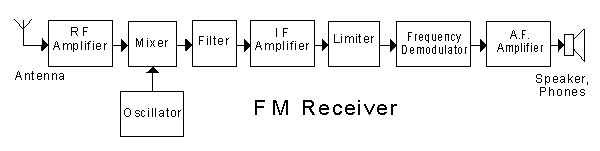
In the block diagram of the receiver shown, the "RF amplifier"
-
decreases random fluctuation noise
-
masks strong noise
-
Correct Answershould produce little internal noise
-
changes the signal frequency
Correct answer: should produce little internal noise
The RF amplifier is the first active stage in the receiver and amplifies very weak incoming signals from the antenna.
To preserve signal quality, it must:
- introduce as little internal noise as possible
- maintain a good signal-to-noise ratio
Any noise added at this stage will be amplified by all following stages.
- It does not decrease random noise.
- It does not mask strong noise.
- Frequency conversion occurs in the mixer stage.
Therefore, the RF amplifier should produce little internal noise.
Last edited by jim.carroll. Register to edit
In the block diagram of the receiver shown, the "mixer"
-
Correct Answerchanges the signal frequency
-
rejects SSB and CW signals
-
protects against receiver overload
-
limits the noise on the signal
Correct answer: A — changes the signal frequency
In a superheterodyne receiver (which this FM receiver is), the mixer combines the incoming RF signal with the locally generated signal from the oscillator. The result is a new signal at the intermediate frequency (IF) — the difference between the RF and oscillator frequencies. This fixed IF is easier to amplify and filter than the original RF signal, which is why the superheterodyne design is so widely used.
The surrounding blocks provide context:
-
RF Amplifier — boosts the weak antenna signal before mixing
-
Oscillator — provides the second input to the mixer
-
Filter — passes only the desired IF, rejecting unwanted mixing products
-
IF Amplifier — amplifies the now-converted signal at the fixed IF
-
B — rejects SSB and CW signals: That is not a mixer function; the filter selects or rejects signals by frequency, and an FM receiver's discriminator naturally ignores AM-type modes.
-
C — protects against receiver overload: Overload protection is a function of AGC (Automatic Gain Control) circuits or attenuators, not the mixer.
-
D — limits the noise on the signal: Noise limiting is performed by the Limiter stage shown later in the chain, which clips amplitude variations before the FM demodulator.
Therefore, the mixer's role is to convert the incoming RF signal to the intermediate frequency by combining it with the oscillator signal.
Last edited by jim.carroll. Register to edit
In the receiver shown, when receiving a signal, the output frequency of the "oscillator" is
-
the same as that of the signal
-
the same as that of the IF amplifier
-
Correct Answerof constant amplitude and frequency
-
passed through the following filter
Correct answer: of constant amplitude and frequency
In a superheterodyne receiver, the local oscillator generates a stable signal which is mixed with the incoming RF signal.
The purpose of this mixing process is to produce an intermediate frequency (IF):
\[ f_{\text{IF}} = |f_{\text{RF}} - f_{\text{LO}}| \]
To ensure proper operation and stable IF output, the oscillator must provide a signal of:
-
constant amplitude
-
constant frequency (for a given tuning setting)
-
It is not the same frequency as the received signal.
-
The IF is produced after mixing.
-
The oscillator output itself is not passed through the following RF filter.
Therefore, the oscillator output is of constant amplitude and frequency.
Last edited by jim.carroll. Register to edit
In the block diagram of the receiver shown, the "limiter"
-
Correct Answerlimits the signal to a constant amplitude
-
rejects SSB and CW signals
-
limits the frequency shift of the signal
-
limits the phase shift of the signal
The demodulator will usually be a "discriminator" and may even be of a "phase-lock-loop" variety. There will be a "limiter" before the descriminator to remove noise peaks and amplitude-changes before detection of the FM signal
Last edited by cmscouler. Register to edit
In the block diagram of the receiver shown, the "frequency demodulator" could be implemented with a
-
product detector
-
Correct Answerphase-locked loop
-
full-wave rectifier
-
low-pass filter
The demodulator will usually be a "discriminator" and may even be of a "phase-lock-loop" variety.
Last edited by cmscouler. Register to edit
In the block diagram of the receiver shown, the "AF amplifier"
-
amplifies stereo signals
-
Correct Answeramplifies speech frequencies
-
is an all frequency amplifier
-
must be fitted with a tone control
Correct answer: amplifies speech frequencies
The AF (audio frequency) amplifier operates at audio frequencies, typically in the range of human hearing.
Its role is to:
-
amplify the recovered audio signal from the detector
-
drive the speaker or headphones
-
It is not specifically for stereo signals.
-
It does not amplify all frequencies.
-
Tone control is optional, not required.
Therefore, the AF amplifier amplifies speech frequencies.
Last edited by jim.carroll. Register to edit
In this receiver, an audio frequency gain control would be associated with the block labelled
-
Correct AnswerAF amplifier
-
frequency demodulator
-
speaker, phones
-
IF amplifier
Correct answer: A — AF amplifier
The AF (Audio Frequency) amplifier is the final amplification stage in the FM receiver chain, boosting the recovered audio signal to a level suitable for driving a speaker or headphones. A volume control (audio frequency gain control) is placed in this stage because it adjusts the strength of the audio signal after demodulation — this is the most practical and effective point to vary loudness for the listener.
- B. Frequency demodulator — This block converts the FM signal's frequency variations into an audio voltage; it is not a gain-adjustable stage and does not control audio volume.
- C. Speaker, phones — These are output transducers that convert electrical signals into sound; they do not contain gain control circuitry.
- D. IF amplifier — The IF (Intermediate Frequency) amplifier operates at the intermediate frequency (before demodulation) and may have AGC applied to it, but AGC controls RF/IF gain to handle signal strength, not audio frequency gain for volume control.
Therefore, an audio frequency gain control (volume control) belongs in the AF amplifier block, where the recovered audio signal is amplified and adjusted before reaching the speaker or headphones.
Last edited by jim.carroll. Register to edit
In the block diagram of the receiver shown, the selectivity would be set by the
-
AF amplifier
-
mixer
-
limiter
-
Correct Answerfilter
Correct answer: filter
Selectivity in a receiver is its ability to accept the desired signal while rejecting signals on nearby frequencies.
In a superheterodyne FM receiver, this is mainly determined by the IF filter, which defines the receiver’s bandwidth.
The filter allows the desired IF signal to pass while attenuating adjacent unwanted signals.
- The AF amplifier operates after demodulation and does not affect RF selectivity.
- The mixer converts frequencies but does not determine bandwidth.
- The limiter removes amplitude variations, not unwanted frequencies.
Therefore, receiver selectivity is set by the filter.
Last edited by jim.carroll. Register to edit
In the FM communications receiver shown in the block diagram, the "filter" bandwidth is typically
-
3 kHz
-
Correct Answer10 kHz
-
64 kHz
-
128 kHz
Correct answer: 10 kHz
In an FM receiver, the filter following the mixer is the IF filter, which determines the receiver’s bandwidth.
For typical narrowband FM voice communication, the transmitted signal bandwidth is determined by:
\[ B \approx 2(\Delta f + f_m) \]
where:
- \(\Delta f\) is the frequency deviation (typically about \(2.5\ \mathrm{kHz}\))
- \(f_m\) is the highest modulating frequency (typically about \(3\ \mathrm{kHz}\))
Substituting:
\[ B \approx 2(2.5 + 3) = 11\ \mathrm{kHz} \]
So an IF filter bandwidth of about 10 kHz is suitable for passing the FM signal without excessive distortion.
- 3 kHz is appropriate for AM or SSB audio bandwidth, not FM IF bandwidth.
- 64 kHz and 128 kHz are far wider than required for narrowband FM and would admit excessive noise.
Therefore, the filter bandwidth is typically 10 kHz.
Last edited by jim.carroll. Register to edit
In the block diagram of the receiver shown, an automatic gain control (AGC) circuit would be associated with the
-
Speaker
-
Correct AnswerIF amplifier
-
RF filter
-
Oscillator
Correct answer: B — IF amplifier
In a superheterodyne FM receiver, Automatic Gain Control (AGC) monitors the signal strength at the IF stage and automatically adjusts the gain of the IF amplifier (and sometimes the RF amplifier) to maintain a consistent output level. When a strong signal arrives, AGC reduces the amplifier's gain; when the signal is weak, gain is increased. This prevents the audio output from being overwhelmed by strong stations or too faint from weak ones.
The diagram shows the signal path: Antenna → RF Amplifier → Mixer → Filter → IF Amplifier → Limiter → Frequency Demodulator → AF Amplifier → Speaker. The IF amplifier is the natural control point because the signal is at a fixed intermediate frequency there, making it straightforward to measure and control its level consistently regardless of the received frequency.
Note: in FM receivers the limiter stage also helps suppress amplitude variations, but AGC is specifically associated with the IF amplifier stage in the block diagram shown.
- A. Speaker — The speaker is a purely passive output transducer; it has no gain to control and receives only the final audio signal.
- C. RF filter — The RF filter is a passive bandpass filter; it selects frequencies but has no variable gain and cannot be controlled by AGC.
- D. Oscillator — The local oscillator sets the conversion frequency for the mixer; AGC does not adjust oscillator output, as that would shift the IF frequency rather than control gain.
Therefore, AGC is associated with the IF amplifier, where signal level is most consistently measured and gain adjustment is most effective in a superheterodyne FM receiver.
Last edited by jim.carroll. Register to edit
In the block diagram of the receiver shown, the waveform produced by the "oscillator" would ideally be a
-
square wave
-
pulsed wave
-
Correct Answersinewave
-
hybrid frequency wave
Correct answer: C — sinewave
In a superheterodyne FM receiver, the oscillator (often called the local oscillator or LO) mixes with the incoming RF signal to produce the intermediate frequency (IF). For this mixing process to work cleanly, the oscillator must produce a pure sinewave. A pure sinewave contains only a single frequency component, which means the mixer generates only the desired sum and difference frequencies without introducing unwanted harmonics or spurious products that would degrade receiver performance.
- A. Square wave — a square wave is rich in odd harmonics; these would mix with the RF signal to produce multiple spurious IF signals, causing interference and poor selectivity.
- B. Pulsed wave — a pulsed waveform contains a wide spectrum of frequency components, making it entirely unsuitable as a stable, single-frequency local oscillator signal.
- D. Hybrid frequency wave — this is not a recognised waveform type in receiver design; it has no meaningful technical definition in this context.
Therefore, the local oscillator in an FM superheterodyne receiver ideally produces a pure sinewave to ensure clean, interference-free frequency conversion to the IF stage.
Last edited by jim.carroll. Register to edit