The Radio Transmitter

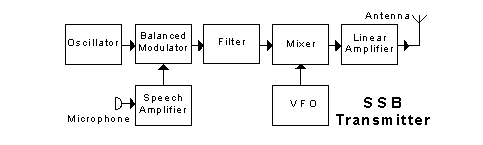
In the transmitter block diagram shown, the "oscillator"
-
is variable in frequency
-
generates an audio frequency tone during tests
-
Correct Answeruses a crystal for good frequency stability
-
may have a calibrated dial
Correct answer: C — uses a crystal for good frequency stability
In an SSB transmitter, the oscillator shown feeds the balanced modulator, where it acts as the carrier frequency source. This carrier is suppressed by the balanced modulator, leaving only the sidebands. Because the final output frequency depends directly on the accuracy of this oscillator, a crystal is used to ensure it remains stable and on a precise frequency. The VFO (Variable Frequency Oscillator) elsewhere in the circuit handles tuning across the band.
- A — is variable in frequency: The variable element in this design is the VFO, which feeds the mixer stage. The oscillator feeding the balanced modulator is a fixed-frequency crystal oscillator, not variable.
- B — generates an audio frequency tone during tests: The oscillator operates at a radio frequency (typically in the MHz range) to act as the carrier. Audio tones for testing would come from the speech amplifier/microphone input side.
- D — may have a calibrated dial: A calibrated dial is a feature of a VFO, which allows tuning across a range of frequencies. A crystal oscillator is fixed to one frequency and requires no tuning dial.
Therefore, the oscillator in this SSB transmitter block diagram uses a crystal to maintain a stable, fixed carrier frequency for the balanced modulator stage.
Last edited by jim.carroll. Register to edit
In the transmitter block diagram shown, the "balanced modulator"
-
balances the high and low frequencies in the audio signal
-
Correct Answerperforms double sideband suppressed carrier modulation
-
acts as a tone control
-
balances the standing wave ratio
Correct answer: performs double sideband suppressed carrier modulation
In an SSB transmitter, the balanced modulator combines the audio signal with the carrier in such a way that the carrier is cancelled out.
This produces a double sideband suppressed carrier (DSB-SC) signal, which contains:
- an upper sideband
- a lower sideband
- no carrier component
This signal is then passed to a filter to remove one sideband, producing the final SSB signal.
- It does not adjust audio frequency balance.
- It is not a tone control.
- It is unrelated to standing wave ratio.
Therefore, the balanced modulator performs double sideband suppressed carrier modulation.
Last edited by jim.carroll. Register to edit
In the transmitter block diagram shown, the "filter"
-
removes mains hum from the audio signal
-
suppresses unwanted harmonics of the RF signal
-
Correct Answerremoves one sideband from the modulated signal
-
removes the carrier component from the modulated signal
Correct answer: removes one sideband from the modulated signal
In an SSB transmitter, the balanced modulator produces a double sideband suppressed carrier (DSB-SC) signal. This signal contains both the upper and lower sidebands, but only one sideband is desired for transmission.
The filter following the balanced modulator is a narrow bandpass filter that selects the wanted sideband and rejects the unwanted sideband. This process creates a true single sideband (SSB) signal.
- removes mains hum from the audio signal is the function of audio filtering in the microphone or speech amplifier stages, not the RF filter shown here.
- suppresses unwanted harmonics of the RF signal is typically done by output filtering after the power amplifier, not at this stage of modulation.
- removes the carrier component from the modulated signal is performed by the balanced modulator itself, not by the filter.
Therefore, the filter’s purpose in this block diagram is to remove one sideband from the modulated signal.
Last edited by jim.carroll. Register to edit
In the transmitter block diagram shown, the "mixer"
-
adds the correct proportion of carrier to the SSB signal
-
mixes the audio and RF signals in the correct proportions
-
Correct Answertranslates the SSB signal to the required frequency
-
mixes the two sidebands in the correct proportions
Correct answer: translates the SSB signal to the required frequency
In this SSB transmitter, the balanced modulator and filter first generate a clean single sideband signal at an intermediate frequency. The mixer then combines this SSB signal with the signal from the VFO.
Mixing produces sum and difference frequencies, effectively shifting the SSB signal to the desired transmit frequency band. This process is called frequency translation or upconversion.
- adds the correct proportion of carrier to the SSB signal is incorrect, the carrier remains suppressed in an SSB transmitter unless deliberately reinserted elsewhere.
- mixes the audio and RF signals in the correct proportions describes the function of the balanced modulator earlier in the chain, not the mixer.
- mixes the two sidebands in the correct proportions is incorrect because only one sideband exists after the filter stage.
Therefore, the mixer’s role is to translate the SSB signal to the required frequency.
Last edited by jim.carroll. Register to edit
In the transmitter block diagram shown, the "linear amplifier"
-
has all components arranged in-line
-
Correct Answeramplifies the modulated signal with no distortion
-
aligns the two sidebands correctly
-
removes any unwanted amplitude modulation from the signal
Correct answer: B — amplifies the modulated signal with no distortion
In an SSB transmitter, the audio information is carried entirely in the amplitude and phase variations of the single sideband signal. A linear amplifier is one whose output is a faithful, proportional copy of its input — it amplifies the signal without introducing clipping, compression, or other non-linear distortion. Non-linear amplification of an SSB signal would create intermodulation products and splatter, corrupting the intelligence and causing interference to adjacent channels.
The block diagram shows the signal path: Oscillator → Balanced Modulator → Filter → Mixer (with VFO) → Linear Amplifier → Antenna. The linear amplifier is the final power stage before the antenna, so it must preserve the envelope of the SSB signal exactly.
- A — "has all components arranged in-line" is wrong; "linear" refers to the amplifier's transfer characteristic (output proportional to input), not a physical layout.
- C — "aligns the two sidebands correctly" is wrong; sideband selection is performed by the filter earlier in the chain, not the final amplifier.
- D — "removes any unwanted amplitude modulation from the signal" is wrong; that describes a limiter or FM discriminator function. SSB relies on amplitude variations to carry the voice signal — removing them would destroy the audio.
Therefore, the linear amplifier's role in an SSB transmitter is to boost the modulated signal to the required power level while preserving its waveform with no distortion.
Last edited by jim.carroll. Register to edit
In the transmitter block diagram shown, the "VFO" is
-
a voice frequency oscillator
-
a varactor fixed oscillator
-
a virtual faze oscillator
-
Correct Answera variable frequency oscillator
Correct answer: D — a variable frequency oscillator
A VFO (Variable Frequency Oscillator) is an oscillator whose output frequency can be tuned across a range, allowing the operator to select the operating frequency. In the SSB transmitter block diagram shown, the VFO feeds the Mixer stage, where its signal is combined with the filtered SSB signal from the Balanced Modulator/Filter chain. By changing the VFO frequency, the operator shifts the final transmitted frequency to the desired channel or band segment. The Linear Amplifier then boosts the mixed signal to the required power level before it reaches the antenna.
- A — voice frequency oscillator: Incorrect. Voice frequencies (300 Hz – 3 kHz) are audio signals derived from the microphone and Speech Amplifier path, not from the VFO.
- B — varactor fixed oscillator: Incorrect. A varactor-tuned oscillator can exist, but the "fixed" part contradicts the purpose of a VFO, which is specifically variable. The abbreviation VFO does not stand for this.
- C — virtual faze oscillator: Incorrect. This is not a recognised term in radio engineering; "virtual faze oscillator" does not exist as a defined circuit type.
Therefore, in an SSB transmitter, the VFO is a Variable Frequency Oscillator that sets the transmit frequency by injecting a tunable carrier into the mixer stage.
Last edited by jim.carroll. Register to edit

In the transmitter block diagram shown, the "master oscillator" produces
-
Correct Answera steady signal at the required carrier frequency
-
a pulsating signal at the required carrier frequency
-
a 800 Hz signal to modulate the carrier
-
a modulated CW signal
Correct answer: A — a steady signal at the required carrier frequency
In a CW (Continuous Wave) transmitter, the master oscillator's sole job is to generate a stable, unmodulated sine wave at the desired transmit frequency. It runs continuously and at a fixed frequency — it does not switch on and off, and it carries no modulation of its own. The Morse keying is applied later in the chain (at the power amplifier stage, as shown by the Morse Key block feeding the Power Amplifier), so the oscillator itself sees no interruption.
The block diagram shows the signal path: Master Oscillator → Driver Buffer → Power Amplifier → Antenna, with the Morse Key controlling the Power Amplifier to produce the on/off keying of the transmitted signal.
- B — a pulsating signal at the required carrier frequency: Incorrect. The oscillator output is continuous and steady; pulsing (keying) happens at the power amplifier stage.
- C — an 800 Hz signal to modulate the carrier: Incorrect. 800 Hz is a typical sidetone frequency used in receivers or monitors to make CW audible, not something generated by the master oscillator.
- D — a modulated CW signal: Incorrect. Modulation (the on/off keying pattern) is not applied until the power amplifier stage; the oscillator produces an unmodulated carrier.
Therefore, the master oscillator produces a steady, stable, unmodulated signal at the required carrier frequency, with keying applied downstream at the power amplifier.
Last edited by jim.carroll. Register to edit
In the transmitter block diagram shown, the "driver buffer"
-
filters any sharp edges from the input signal
-
drives the power amplifier into saturation
-
Correct Answerprovides isolation between the oscillator and power amplifier
-
changes the frequency of the master oscillator signal
Correct answer: provides isolation between the oscillator and power amplifier
In a CW transmitter, the master oscillator must maintain a stable frequency. Any changes in load can cause frequency pulling or drift.
The driver buffer is placed between the oscillator and the power amplifier to prevent this. It presents a constant, stable load to the oscillator while supplying sufficient drive to the next stage. This isolation ensures that variations in the power amplifier or antenna do not affect the oscillator frequency.
- Filtering sharp edges is the role of filters or waveform-shaping circuits, not a buffer amplifier.
- Driving the power amplifier into saturation is undesirable in this context and is not the buffer’s function.
- Changing frequency requires mixers, modulators, or multipliers, not a buffer stage.
Therefore, the driver buffer’s purpose is to provide isolation between the oscillator and the power amplifier.
Last edited by jim.carroll. Register to edit
In the transmitter block diagram shown, the "Morse key"
-
turns the DC power to the transmitter on and off
-
Correct Answerallows the oscillator signal to pass only when the key is depressed
-
changes the frequency of the transmitted signal when the key is depressed
-
adds an 800 Hz audio tone to the signal when the key is depressed
Correct answer: allows the oscillator signal to pass only when the key is depressed
In a CW (continuous wave) transmitter, the Morse key is used to control when the RF carrier is transmitted.
When the key is:
- depressed → the RF signal from the oscillator is allowed to pass through to the amplifier stages and antenna
- released → the RF signal is interrupted
This produces the on–off keying required for Morse code transmission.
- It does not switch the entire DC power to the transmitter.
- It does not change the transmitted frequency.
- CW transmission does not involve adding an audio tone to the RF signal.
Therefore, the Morse key allows the oscillator signal to pass only when the key is depressed.
Last edited by jim.carroll. Register to edit
In the transmitter block diagram shown, the "power amplifier"
-
Correct Answerneed not have linear characteristics
-
amplifies the bandwidth of its input signal
-
must be adjusted during key-up conditions
-
should be water-cooled
Correct answer: need not have linear characteristics
In a CW (continuous wave) transmitter, the signal is a single RF carrier that is simply switched on and off by the Morse key. There is no amplitude or phase modulation that must be preserved.
Because the waveform contains no modulation information, the power amplifier does not need to operate linearly. It can be run in a more efficient non-linear class (such as Class C) without distorting the transmitted signal.
- amplifies the bandwidth of its input signal is incorrect, amplifiers increase power or voltage, not bandwidth.
- must be adjusted during key-up conditions is incorrect, tuning and adjustment are normally done with the transmitter keyed and producing RF.
- should be water-cooled depends on power level and design, not on the basic function of a CW power amplifier.
Therefore, in a CW transmitter the power amplifier need not have linear characteristics.
Last edited by jim.carroll. Register to edit
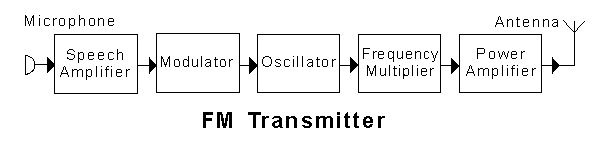
In the transmitter block diagram shown, the "speech amplifier"
-
Correct Answeramplifies the audio signal from the microphone
-
is a spectral equalization entropy changer
-
amplifies only speech, while discriminating against background noises
-
shifts the frequency spectrum of the audio signal into the RF region
Correct answer: A — amplifies the audio signal from the microphone
In an FM transmitter, the microphone converts sound into a weak electrical audio signal. The speech amplifier is the first stage in the signal chain and simply boosts this low-level audio signal to a level suitable for driving the modulator stage. It is a straightforward audio amplifier — it does not filter, discriminate, or shift frequencies.
- B — "spectral equalization entropy changer" is not a real technical term; this is a nonsense distractor.
- C — amplifies only speech while discriminating against background noise describes a noise-cancelling microphone or a noise gate circuit, not a general speech amplifier stage.
- D — shifts the frequency spectrum into the RF region describes the function of the oscillator and frequency multiplier stages later in the chain, not the speech amplifier.
Therefore, the speech amplifier has the straightforward purpose of boosting the microphone's audio output to a usable level before it reaches the modulator.
Last edited by jim.carroll. Register to edit
In the transmitter block diagram shown, the "modulator"
-
is an amplitude modulator with feedback
-
is an SSB modulator with feedback
-
causes the speech waveform to gate the oscillator on and off
-
Correct Answercauses the speech waveform to shift the frequency of the oscillator
Correct answer: causes the speech waveform to shift the frequency of the oscillator
In an FM transmitter, the modulator applies the audio (speech) signal to the oscillator in such a way that the oscillator’s frequency varies in accordance with the speech waveform.
This produces frequency modulation:
-
the carrier frequency shifts above and below its centre frequency
-
the amount of shift depends on the amplitude of the speech signal
-
It is not an amplitude modulator.
-
SSB modulation is a different process.
-
Gating the oscillator on and off would produce CW, not FM.
Therefore, the modulator causes the speech waveform to shift the frequency of the oscillator.
Last edited by jim.carroll. Register to edit
In the transmitter block diagram shown, the "oscillator" is
-
an audio frequency oscillator
-
Correct Answera variable frequency RF oscillator
-
a beat frequency oscillator
-
a variable frequency audio oscillator
Correct answer: a variable frequency RF oscillator
In an FM transmitter, the oscillator generates the radio frequency (RF) carrier signal that is to be modulated by the audio input.
This RF signal is then passed through stages such as the frequency multiplier and power amplifier before being transmitted.
- An audio frequency oscillator would produce audio signals, not RF.
- A beat frequency oscillator (BFO) is used in receivers for CW detection.
- A variable frequency audio oscillator would not generate an RF carrier.
Therefore, the oscillator in the transmitter is a variable frequency RF oscillator.
Last edited by jim.carroll. Register to edit
In the transmitter block diagram shown, the "frequency multiplier"
-
translates the frequency of the modulated signal into the RF spectrum
-
changes the frequency of the speech signal
-
Correct Answerproduces a harmonic of the oscillator signal
-
multiplies the oscillator signal by the speech signal
The Frequency Multiplier stage is an RF amplifier with a tuned output - the output tuned to a harmonic of the input signal.
Last edited by cmscouler. Register to edit
In the transmitter block diagram shown, the "power amplifier"
-
increases the voltage of the mains to drive the antenna
-
amplifies the audio frequency component of the signal
-
amplifies the selected sideband to a suitable level
-
Correct Answeramplifies the RF signal to a suitable level
Correct answer: amplifies the RF signal to a suitable level
In a transmitter, the power amplifier is the final RF stage before the signal is sent to the antenna.
Its purpose is to increase the power level of the RF signal so that sufficient energy is radiated.
- It does not increase mains voltage.
- Audio amplification occurs in earlier stages.
- Sideband selection occurs before the power amplifier.
Therefore, the power amplifier amplifies the RF signal to a suitable level.
Last edited by jim.carroll. Register to edit